
If you are looking for an honest Luma Dream Machine review, checking Luma AI pricing, or searching for a fast Luma AI alternative, this comprehensive 2026 benchmark guide provides complete technical and pricing clarity.
Luma Dream Machine Pricing & Verdict: Direct Answer
Luma Dream Machine is a cutting-edge AI video platform powered by the Ray 2 / Ray 3.14 diffusion engine that costs between $9.99 and $94.99 per month, with individual 5-second video generations costing 1 credit (~$0.05 to $0.08 per clip on paid tiers).
The key thing to know: While Dream Machine produces extraordinary physical dynamics (water, smoke, lighting reflections), free and entry-level users face heavy queue delays of 5–15 minutes during peak hours, and unused monthly credits expire without rollover.
- Pricing Overview: Free tier (~30 generations/month with watermark & slow queue), Lite is $9.99/month (120 credits), Standard is $29.99/month (400 credits), Plus is $64.99/month (1,000 credits), and Pro is $94.99/month (2,000 credits).
- Core Strengths: Photorealistic lighting transport, Start/End frame interpolation, and intuitive camera movement presets (Pan, Orbit, Dolly).
- Primary Drawbacks: Long queue wait times on free/Lite tiers, lack of credit rollover, and single-model vendor lock-in.
- Top Alternative Recommendation: For creators who require instant sub-60s render times, multi-model choice, and commercial licensing, test Vibe Video's AI Video Studio with complimentary free starter credits.
What Is Luma Dream Machine?
Luma Dream Machine is a cloud-native generative video engine developed by Luma AI, a synthetic media and computer vision company founded in 2021 by Amit Jain and Alex Yu. Originally known for pioneering Neural Radiance Fields (NeRFs) and interactive 3D Gaussian Splatting, Luma launched Dream Machine in mid-2024 to bring realistic 3D world physics into 2D video diffusion.
Dream Machine is driven by Luma's Ray 2 and Ray 3.14 transformer-based video diffusion architectures. Key platform features include:
- Keyframe Interpolation: Creators can supply both a start frame and an end frame, allowing the AI to interpolate coherent physical transitions between disparate states.
- Camera Movement Engine: Provides explicit camera trajectories including 360-degree Orbits, Crane Up/Down, Push In, and Pan Left/Right.
- Extend Video: Lengthens generated clips in 5-second increments to build sequential scene progressions.
- Image-to-Video & Text-to-Video: Converts text prompts or 2D image uploads into 5-second MP4 clips at 24fps.
To test an alternative workflow with multiple underlying video diffusion models, visit the Luma Alternative Workspace on VibeVideo.
 Luma Dream Machine official web application and generative video workspace in 2026.
2026 Luma AI Pricing Table
Luma operates on a credit-based monthly subscription model where 1 credit equals one 5-second generation:
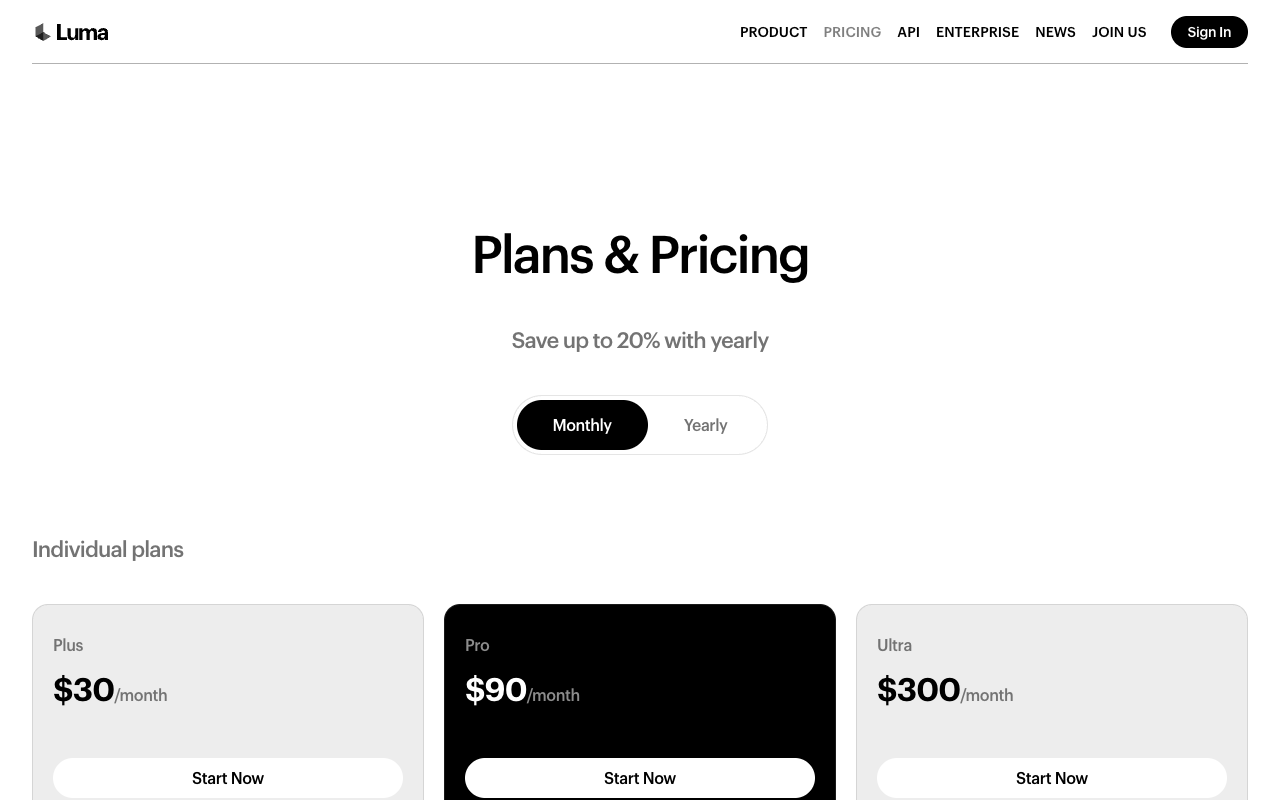 Luma AI official subscription tiers and monthly generation quotas.
| Plan | Public Monthly Price | Annual Billing Equivalent | Monthly Credits Included | Effective Cost per 5s Video | Queue Priority |
|---|---|---|---|---|---|
| Free | $0 | $0 | ~30 credits / mo | $0.00 | Standard (5–15 min wait, watermarked) |
| Lite | $9.99 / mo | $7.99 / mo | 120 credits / mo | ~$0.083 | Priority queue |
| Standard | $29.99 / mo | $23.99 / mo | 400 credits / mo | ~$0.075 | High priority |
| Plus | $64.99 / mo | $51.99 / mo | 1,000 credits / mo | ~$0.065 | Ultra-high priority |
| Pro | $94.99 / mo | $75.99 / mo | 2,000 credits / mo | ~$0.047 | Maximum priority |
Note: Pricing reviewed from public pricing pages in 2026. Unused monthly credits reset each billing cycle and do not accumulate.
Luma Dream Machine Pros
1. Exceptional Light Physics & Volumetric Reflections
Because Luma has deep roots in 3D NeRF rendering, Ray 3.14 handles specular highlights, ambient light bounce, refraction, and water reflections with superior physical realism compared to 2D-only diffusion models.
2. Dual Keyframe Control (Start & End Frames)
The ability to anchor both the beginning and the end of a shot gives filmmakers and motion designers predictable control over scene compositions and camera blocking.
3. High Initial Motion Energy
Unlike models that produce subtle or near-static image animations, Dream Machine naturally introduces energetic subject motion and dynamic background action.
Luma Dream Machine Cons & Common Criticisms
1. Severe Peak-Hour Queue Throttling
During peak North American and European creative hours, free and Lite tier generation requests are queued behind enterprise workloads. Users frequently report waiting between 5 and 20 minutes for a single 5-second render.
2. Credit Expiration Policy
Unused subscription credits expire every 30 days. If a creator subscribes to the Standard plan ($29.99/mo) and renders only 100 clips in a month, the remaining 300 credits ($22.50 value) are forfeited.
3. Morphing & Anatomical Drift in Extensions
When using the "Extend" feature to generate 10 to 20-second sequences, character facial features and clothing textures frequently morph or deform as temporal context degrades.
Luma Dream Machine vs VibeVideo Comparison
| Feature | Luma Dream Machine | VibeVideo |
|---|---|---|
| Foundation Architecture | Proprietary Ray 2 & Ray 3.14 only | Multi-model hub (Seedance 2.0, Gemini Omni Video, etc.) |
| Average Render Latency | 3–15 minutes (traffic dependent) | Under 60 seconds cloud render |
| Free Tier Experience | Watermarked, slow queue | Unwatermarked starter credits, commercial test rights |
| Credit Rollover | No (monthly reset) | Flexible credit packs with no punishing expiration |
| Commercial Rights | Paid plans only | Included across all generation tiers |
| Multi-Model Testing | Not available | Side-by-side comparison across top diffusion models |
When to Choose Luma vs When to Choose VibeVideo
- Choose Luma Dream Machine if: You specifically need dual-keyframe (start-to-end) interpolation between two distinct images and are willing to wait for priority queue rendering on a paid subscription.
- Choose VibeVideo if: You need fast, queue-free video generation for social media, marketing, and commercial production, with the flexibility to choose from multiple leading AI video models in one interface. Try VibeVideo's AI Video Generator today.
Frequently Asked Questions (FAQ)
What makes Luma Dream Machine different from Midjourney or Runway?
Luma Dream Machine is built by 3D computer vision researchers, resulting in stronger volumetric lighting, reflection handling, and spatial depth. Unlike Midjourney (which specializes in stills), Luma is a dedicated video engine; unlike Runway, it uses a flat 1 credit per generation system rather than per-second metering.
How much does Luma AI cost per month?
Luma offers four paid tiers: Lite ($9.99/mo for 120 credits), Standard ($29.99/mo for 400 credits), Plus ($64.99/mo for 1,000 credits), and Pro ($94.99/mo for 2,000 credits).
Is Luma Dream Machine free to use?
Yes, Luma provides a free tier with roughly 30 generations per month. However, free outputs include a watermark, lower resolution, and significantly slower queue processing times.
Do Luma AI credits roll over each month?
No. Monthly subscription credits expire at the end of each billing cycle. Unused credits are not carried forward to subsequent months.
What is the best alternative to Luma Dream Machine?
VibeVideo is the top alternative for creators seeking rapid sub-60 second render times, multi-model flexibility, and full commercial usage rights without queue bottlenecks.
Data sources: Luma AI official documentation, user community feedback, and comparative benchmark data compiled by the Vibe Video research lab.